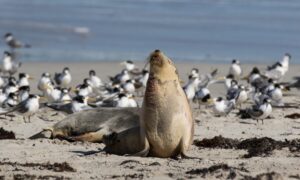
Seal Bay has temporarily paused its guided beach tours after a suspected case of H5 bird flu was detected in a wild seabird near the Kangaroo Island sea lion colony.
South Australia has identified a further 11 suspected cases of H5 bird flu following preliminary testing in Adelaide, with all of the cases involving greater crested terns found across the Limestone Coast and Kangaroo Island.
Samples from the birds have been sent to the Australian Centre for Disease Preparedness in Geelong for confirmatory testing.
Seven of the birds were located along the Limestone Coast, including three found together at Beachport, one at Cape Jaffa, one at Southend and two birds found separately at Port MacDonnell.
Another four birds were discovered on Kangaroo Island, including three found together at D’Estrees Bay and one at Seal Bay.
Seal Bay Conservation Park will remain open, with guided tours continuing from its boardwalk. However, access to the beach has been temporarily paused to help protect its vulnerable Australian sea lion colony.
Visitors will instead be offered an enhanced guided boardwalk experience, allowing them to continue viewing the sea lions while reducing direct interaction with their environment.
The beach portion of Seal Bay tours has previously been paused during periods of hot weather and during the recent harmful algal bloom event.
Authorities have stressed that there continue to be no detections of H5 bird flu in poultry or other livestock, and there is no evidence of mass animal deaths anywhere in Australia.
The risk to human health also remains low.
Wildlife surveillance and engagement with the primary industries sector are continuing as authorities investigate the latest suspected cases and prepare for the potential spread of the virus.
South Australians are being urged to remain vigilant and report any sick or dead birds or other wildlife.
People should not touch or approach affected animals. Instead, they should record the location and details of what they have seen before contacting the Emergency Animal Disease Hotline on 1800 675 888.
Further information and details about upcoming community information forums are available through the South Australian Government’s bird flu website.