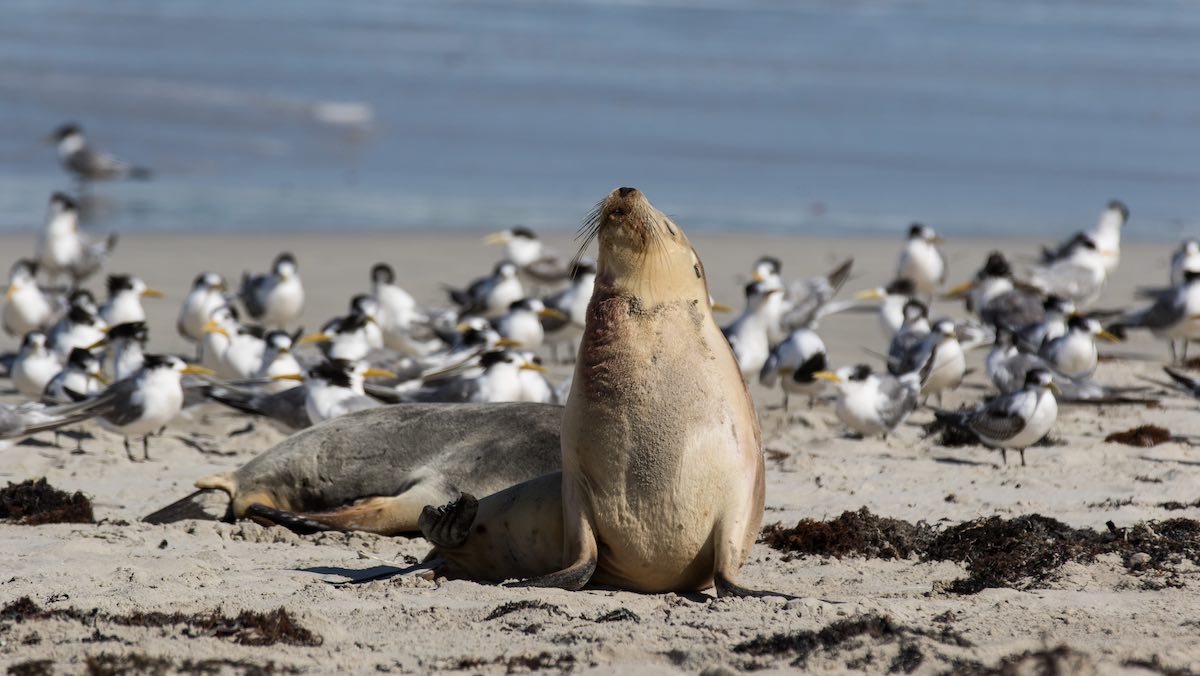

One of South Australia’s most treasured wildlife destinations has become the latest frontline in the state’s bird flu response, with H5N1 detected at Kangaroo Island’s world-renowned Seal Bay.
Four greater crested terns have tested positive to H5 bird flu on Kangaroo Island, including one found at Seal Bay, home to one of the largest breeding colonies of Australian sea lions and a critical habitat for the endangered species.
The Australian Marine Conservation Society (AMCS) has warned the detection signals a major escalation, with local transmission of the virus among native wildlife now considered highly likely.
Australian sea lions are found nowhere else in the world, with the population estimated at just 12,000 individuals. Conservationists fear the species could face devastating impacts if the virus spreads to marine mammals, following major outbreaks overseas.
AMCS Campaigns Director Alexia Wellbelove said, “This is the news we feared but predicted given the experience of bird flu internationally. Endangered Australian sea lions are now on the frontline of the potential wildlife crisis, and a positive detection in a greater crested tern at one of the largest breeding colonies means we must be on high alert.”
International outbreaks have shown H5N1 can spread beyond birds, with the virus linked to the deaths of tens of thousands of marine mammals. “In South America, this virus killed 30,000 sea lion pups in just six months following transmission from birds to marine mammals,” said Alexia. “On our own Heard Island, it killed more than 13,000 elephant seal pups in a single season. With a positive bird flu detection at this important colony, we now have to face the very real possibility of similar devastation here at home, in a species already teetering on the edge.”
Alexia said the Australian sea lion population could not withstand similar losses.
“This is no longer a question of prevention. The Federal Government must act immediately to establish the $200 million national wildlife resilience fund we have been calling for since June, focused on emergency protection and recovery for our most at-risk species.”
The Seal Bay colony is one of Kangaroo Island’s most significant conservation sites and accounts for around five per cent of the global Australian sea lion population.
The South Australian Government continues to conduct targeted surveillance of wild birds and wildlife, while urging the community to report any sick or dead animals.
South Australians are reminded to avoid touching sick or dead wildlife, record what they see and report suspected cases through the Emergency Animal Disease Hotline on 1800 675 888.