
The documentary is one of celebration and tragedy, with quotes from famous writers, poets and thinkers, and an original score by Laura Masotto heightening nostalgia for place and connection to family and lovers.
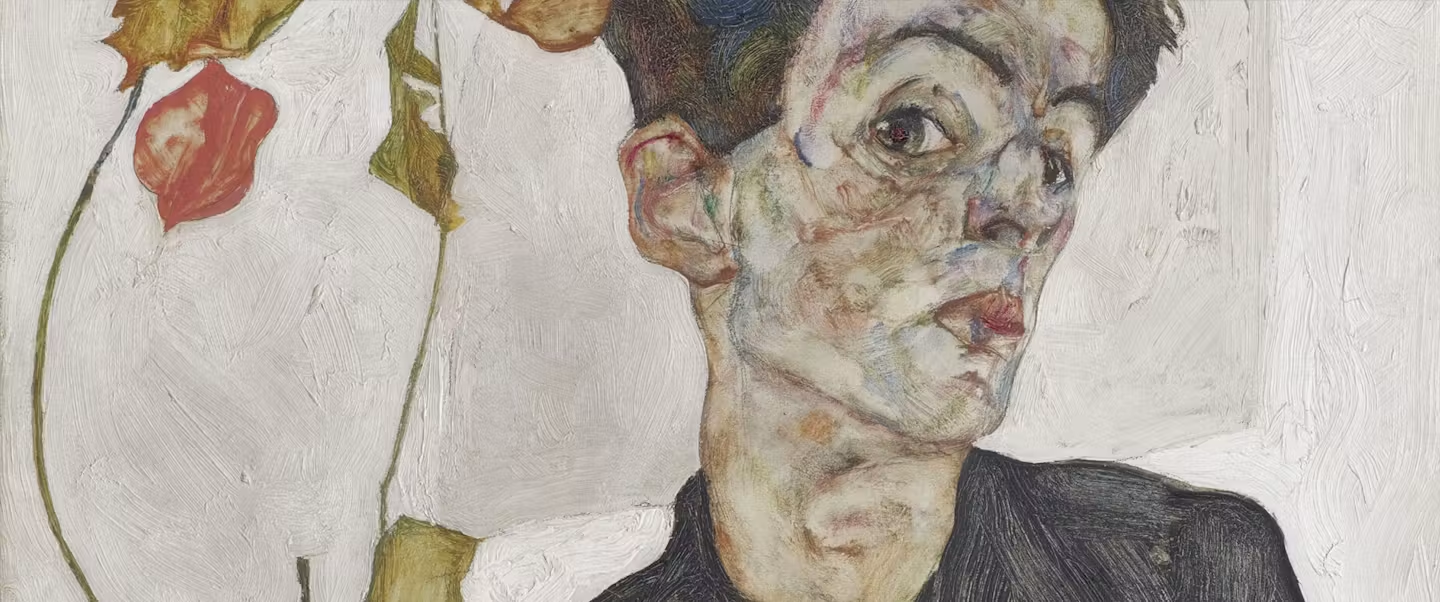
Austrian Expressionist painter Egon Schiele was a renegade of his World War I time, depicting nudes as masturbatory and monstrous, his lines twisted and vulgar. As the title of Michele Mally’s documentary suggests, he defied artistic morals and pushed those same boundaries in the way he lived.
Taboo. Egon Schiele tells of the short life of one of the greatest artists of the early twentieth century. Set in Český Krumlov – Shiele’s mother’s hometown – and moving through Vienna and Prague, where Shiele thrived artistically, the film is narrated in Italian by debut actress Erika Carletto and voiced over in English. It’s a strange narration to get your head around in thinking about a Czech painter, but Carletto does a beautiful job looking through a small window or sitting on a single bed, singing old folk songs from Shiele’s youth, reading from his diaries and sketch books, and speaking directly into the camera. She embodies the idea that ‘taboo’ might refer to fragility as the mirror of our budding wounds (to paraphrase the film), rather than sex.
Through Carletto and a handful of experts that include the likes of art historians and curators, archivists and museum directors, and psychoanalysts and philosophers, we learn of Shiele’s complex ties to the female body, and the intense relationships he formed with his models. First there was Gerti – his sister and best friend. Some insist there were incestual tendencies, though they’ve nothing to go on but possibly innocent anecdotes that can no longer be defended (the siblings sharing a hotel room on an international holiday, for instance). Wally Neuzil follows, whom he loved when he met her at sixteen. Their relationship contributed to his twenty-four-day imprisonment for kidnapping a minor and distribution of pornography. Despite his deep feelings for Neuzil, Shiele saw her as prospectless compared to the woman he eventually married, Edith Harms. Aside from Gerti, who lived to eighty-six, the women failed to live to any kind of ripe age, Wally dying at twenty-three and Edith at twenty-four, six months pregnant with their first child. Shiele, himself, was only twenty-eight when he died of the Spanish flu, leaving behind around 3,000 known drawings and 400 paintings.
The film interestingly uses the writer Franz Kafka as a touchstone, though Kafka and Shiele had never met. Their timelines and whereabouts as Austrian-Czechs were similar, as were their styles, but the greatest marker of their connection is the poetically-summoned Halley’s Comet in 1910, which they likely searched for in the sky as it flew over Prague.
Alongside the astronomical spectacle, the documentary points to major events during Shiele’s career as time-placers: the births and deaths of other artists, actors and sports figures, the start of revolutions and the wars that raged. It’s an interesting contrast to the artist’s short career, suggesting the enormity of forward momentum in the ten or so years of Shiele’s profession. The world transforms at every instant, and some people do more to ensure that it does.
The documentary is one of celebration and tragedy, with quotes from famous writers, poets and thinkers, and an original score by Laura Masotto heightening nostalgia for place and connection to family and lovers, themes Shiele returned to over and over again in his work. It’s a solid, lyrical summary that will speak volumes to art lovers.
Reviewed by Heather Taylor-Johnson
Rating 4 out of 5
Distributor: Sharmill Films